1
Tornado and Straight-Line Wind Damage
Emergency Wind damage covers anything from missing shingle tabs and torn ridge caps to whole sections of decking pulled off by tornadic winds or downbursts. It's the most urgent roof problem because an open roof lets in water right away, and spring storms often come back to back.
Why it happens here Oklahoma ranks among the windiest states, and central Oklahoma sees supercells every spring that can produce tornadoes and 60–80+ mph straight-line winds. The 1999 and 2013 EF5 tornadoes in Moore are the extreme cases, but smaller events strip roofs every year. Shingles that have lost their seal from summer heat lift much more easily, and older 3-tab roofs on post-war homes were never rated for today's wind standards. If a damaged roof isn't covered before the next storm cell, interior losses climb fast.
Signs to watch for - Shingles or tabs lying in the yard or street
- Exposed felt or bare decking visible from the ground
- Lifted or missing ridge caps
- Bent or torn-off flashing and vents
- Water dripping into the attic during or after a storm
- Tree limbs resting on the roof
Local patterns We see clusters of wind damage after May storm outbreaks in Moore, south OKC and Midwest City. Exposed lots near Lake Hefner and the open ground around Tinker AFB take strong gusts. Mature trees in Crown Heights and Edgemere Park add limb-impact damage during storms and ice events.
Our fix Emergency tarping or board-up the same day whenever possible, photo documentation for your insurer, then a permanent repair or full replacement with wind-rated shingles and correct nailing patterns.
2
Hail Bruising and Impact Damage
Serious When hail hits asphalt shingles it can fracture the fiberglass mat, knock granules off and break the seal strip. The roof usually looks fine from the ground, but each bruise becomes a weak spot that lets water in and shortens the roof's life by years.
Why it happens here Oklahoma City is one of the most hail-prone metros in the country. Lots of homes take several claim-worthy hailstorms in a single decade, and stones over an inch happen nearly every season. Since the damage is mostly invisible from the street, people often miss the window to file a claim. Then the bruised spots start leaking a year or two later, when the insurer may call it wear and tear. A careful, documented inspection soon after a storm matters a lot here.
Signs to watch for - Dents on gutters, downspouts, vents or AC fins
- Dark spots on shingles where granules are missing
- Heavy granule buildup in gutters or at downspout outlets
- Soft, bruised spots you can feel when pressing on shingles
- Cracked or split shingles
- Dings on the hood or roof of a car parked outside
Local patterns Hail paths often run across north OKC, Bethany, Warr Acres and The Village in a single storm. In Moore, a lot of roofs replaced after 2013 are now on their second or third hail event. Ridge vents and turtle vents on 1950s ranches dent easily, which makes them a handy damage marker.
Our fix A detailed hail inspection with test squares, photos and measurements, then help with your insurance claim and either targeted repair or full replacement, often with Class 4 impact-resistant shingles.
3
Flashing Failures and Roof Leaks
Serious Flashing is the metal that seals the spots where the roof meets chimneys, walls, skylights, valleys and pipes. When it corrodes, pulls loose or loses its sealant, water gets behind the shingles and into the decking, insulation and ceilings.
Why it happens here Spring storms in OKC dump a lot of rain in a short time, which pushes water hard through valleys and against chimney flashing. Foundation movement from our shrink-swell clay can shift framing enough to open flashing joints. Summer heat dries out sealants and rubber pipe boots in just a few seasons. Older homes in Heritage Hills and Mesta Park have complicated rooflines with dormers, valleys and masonry chimneys, so there are a lot more places for a leak to start.
Signs to watch for - Brown water stains on ceilings or walls
- Damp insulation or dark streaks on attic rafters
- Rusted, lifted or caulk-patched flashing
- Cracked rubber boots around plumbing vents
- Leaks that only show up in wind-driven rain
- Peeling paint near chimneys or dormers
Local patterns Chimney and dormer leaks are common in Heritage Hills, Mesta Park and the Paseo Arts District. Failed pipe boots show up constantly on 1970s–1990s homes in Moore and Bethany. Foundation-related flashing gaps turn up all over the clay-heavy south side.
Our fix We trace the leak to where it actually starts, replace the step, counter or valley flashing and pipe boots, fix any rotted decking, and make sure the repair matches the existing roof.
4
Rotted Decking Hidden Under Multiple Overlays
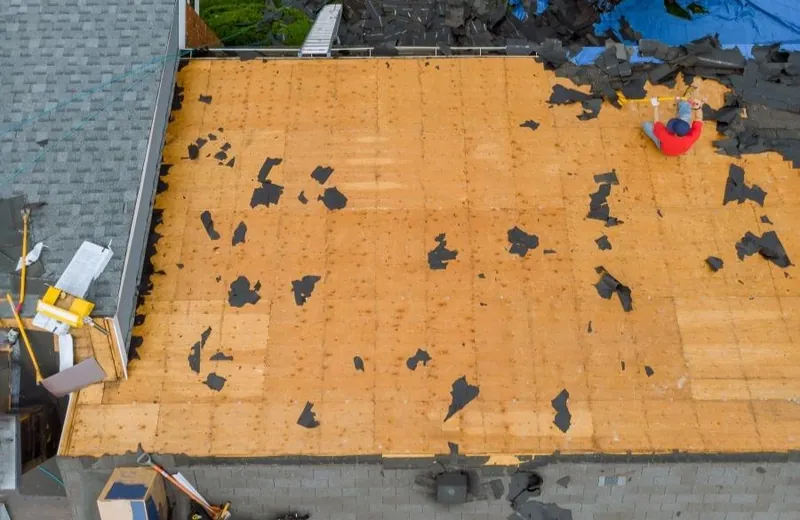
Serious Many older homes have two or three layers of shingles nailed over each other. Years of small leaks can rot the plywood or plank decking underneath without anyone noticing. It adds weight, traps heat, and the problem only shows up once the old layers come off.
Why it happens here In the decades after WWII, re-covering over an old roof was the cheap way to go, so thousands of brick ranches in Capitol Hill, Del City, Midwest City and Warr Acres have hidden overlays now. Each extra layer holds more heat, which speeds up aging in OKC summers, and it hides leaks until the wood underneath is soft. Most local codes cap a roof at two layers, so a full tear-off is often required, and rotted decking can grow the size of the job.
Signs to watch for - Sagging or wavy rooflines
- Spongy spots when walking on the roof
- Thick, stacked shingle edges at the eaves
- Daylight showing through attic boards
- Musty odors or mold in the attic
- Nails backing out through shingles
Local patterns This is very common in 1940s–1960s neighborhoods: Capitol Hill, Del City, Midwest City near Tinker AFB, Warr Acres and The Village. These modest-pitch ranch homes often have plank decking with gaps that newer shingles and today's codes don't allow for.
Our fix A full tear-off down to the deck, replacing rotted boards or adding new sheathing, and documenting code-required items so your insurance supplement or estimate has no surprises.
5
Poor Attic Ventilation and Heat-Aged Shingles
Moderate An attic without enough intake and exhaust venting traps heat and moisture. In an Oklahoma summer, that heat cooks shingles from underneath, warps decking, pushes cooling bills up and can void a manufacturer's shingle warranty.
Why it happens here July and August highs in OKC sit in the mid-90s, and 100°F days are common. An attic without proper airflow can go past 140°F. Lots of mid-century homes were built with a couple of small gable vents, which falls well short of the balanced soffit-and-ridge setups shingle makers now require. That heat speeds up blistering, curling and granule loss, so a 25-year shingle can be worn out in about 15.
Signs to watch for - Blistered or curled shingles, worst on south and west slopes
- An attic that feels like an oven on summer afternoons
- High electric bills and upstairs rooms that won't cool
- Frost or condensation on attic nails in winter
- Painted-over or blocked soffit vents
- Warped or delaminating roof decking
Local patterns We find undersized vents across Bethany, Warr Acres, Del City and Midwest City ranches, and in older two-story homes in Crown Heights. Newer homes near Lake Hefner and Quail Creek sometimes have mixed venting styles that work against each other.
Our fix We calculate how much ventilation your attic actually needs, then add or rebalance soffit intake, ridge vents or powered vents, usually as part of a repair or replacement.
6
Ponding and Membrane Damage on Flat Roofs
Moderate Ponding means water sitting on a low-slope roof for more than 48 hours after it rains. Add heat blistering and hail punctures, and it breaks down built-up, modified bitumen, TPO and EPDM membranes, which leads to leaks, deck rot and higher repair bills.
Why it happens here Commercial roofs in OKC take heavy spring rain, hail and long stretches of summer sun. Older roofs on early-1900s brick buildings often sag, or their drains and scuppers clog, so water pools. Hail can puncture single-ply membranes without anyone noticing, and summer heat lifts blisters in older built-up and mod-bit roofs. Parapet walls on older buildings add more seams that need upkeep.
Signs to watch for - Standing water a couple of days after rain
- Blisters, bubbles or cracks in the membrane
- Open seams or lifted edges
- Clogged drains, scuppers or gutters
- Leaks or stains on top-floor ceilings
- Cracked parapet coping or masonry
Local patterns This is common on historic brick warehouses in Bricktown, Downtown and Stockyards City, on loft conversions in Midtown and Uptown, and on strip centers in Del City and Midwest City. Parapet flashing is often the weakest point on Stockyards City buildings.
Our fix A core sample and moisture check, then targeted patching, coatings, tapered insulation to fix drainage, or a full membrane replacement in TPO, EPDM or modified bitumen.
7
Granule Loss and Curling on Aging 3-Tab Shingles
Minor As asphalt shingles get older they shed their protective granules, and the edges start to curl or cup. It isn't an emergency yet, but it means the roof is nearing the end of its life and won't hold up well in the next big wind or hail storm.
Why it happens here Strong UV and summer heat in OKC break down asphalt faster than in milder climates. Cheaper 3-tab shingles, which are still common on post-war and 1980s homes, lose granules and curl sooner than architectural shingles. Freeze-thaw cycles in winter make it worse. Curled tabs catch wind easily, so a roof like this can go from ugly to leaking in one spring storm.
Signs to watch for - Edges of shingles curling up or cupping
- Bald, shiny patches where granules are gone
- Granules piling up in gutters
- Cracks along shingle tabs
- Uneven color or streaking
- A roof older than 15–20 years
Local patterns We see a lot of this in Capitol Hill, Valley Brook, Forest Park, Warr Acres and older parts of Del City, where 3-tab roofs from the 1990s and early 2000s are still up there. South- and west-facing slopes usually go first.
Our fix An honest condition report, with spot repairs and maintenance if the roof has life left, or a planned replacement with architectural or impact-resistant shingles before storm season if it doesn't.